
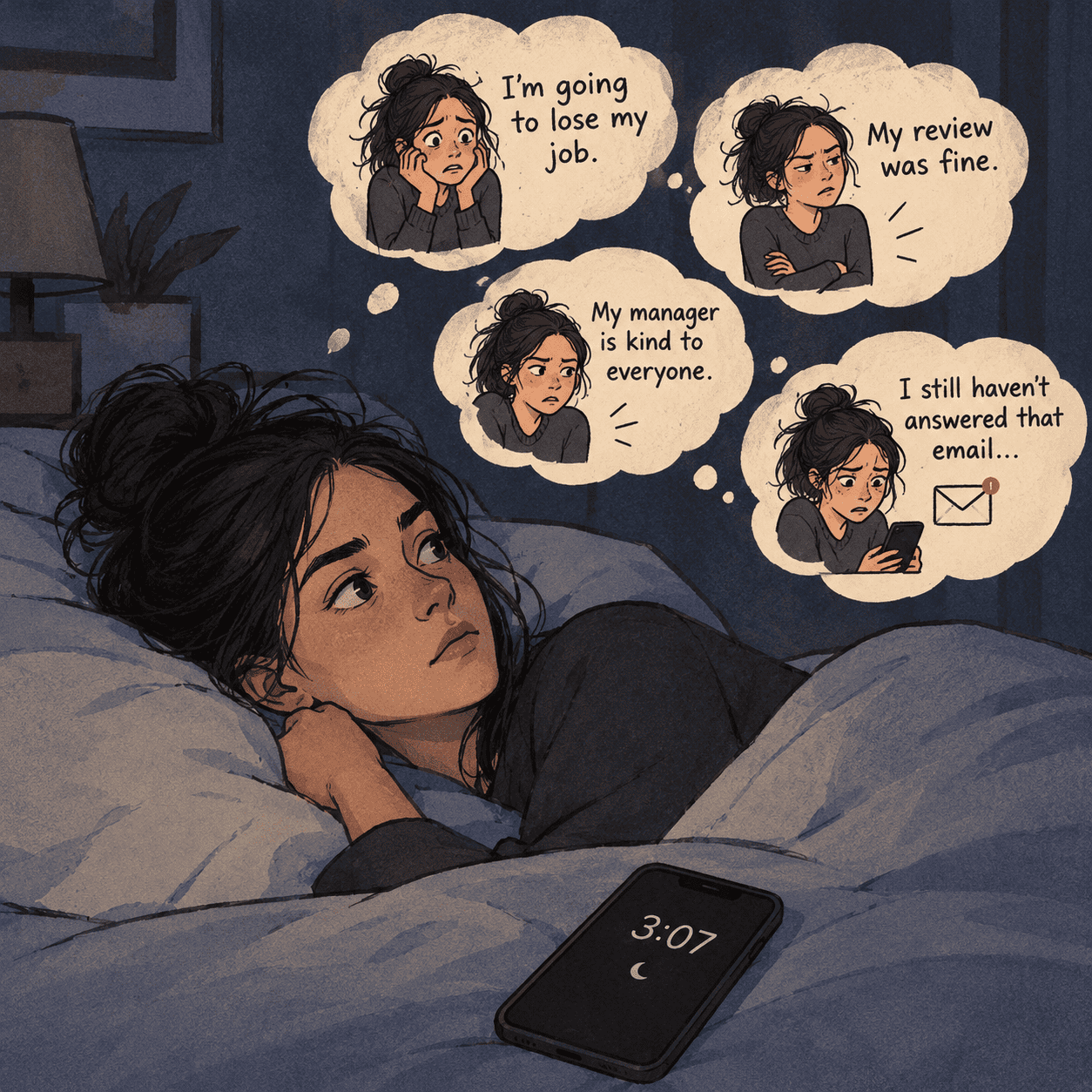
3:07am, round four
The clock on my phone said 3:07, and I had been arguing with my own head for close to an hour.
It started with one small line that showed up the moment I woke, which was that I was going to lose my job. So I answered it the way I always did, because leaving a thought like that unanswered felt like leaving the front door open.
My review last month was fine, I told it. The thought came straight back with something sharper. It said my manager is kind to everyone, so a kind review means nothing, and then it reminded me about the email from Tuesday that I still hadn’t answered.
That was round four, and by then my jaw was tight and my heart was going faster than it should for someone lying still in the dark. And yet I kept going, because I was sure the next answer would be the one that settled it.
The therapist Emma McAdam describes this exact pattern. If a thought tells you that you’re a terrible person and you reply that you do good things, the thought fires back with “Oh yeah? What about how you screwed that thing up at work yesterday?” Every reply hands it something new to work with.
On a forum for overthinkers, people describe the pull that keeps you in it as needing to think it through “one more time”. In the moment that feels like useful work, which is why you only notice the pattern once you’re an hour deep and wide awake.
If you feel trapped by your own thoughts at night, this is probably your version of round four.
What got me out of it that night was so small that I didn’t trust it for weeks, and it only worked because I finally understood why I kept losing.
Why I was losing every argument
The psychologist Nick Wignall has a name for what I was doing. He calls it the Sleep Effort Paradox, and the idea is that the harder you work to solve the problem of not sleeping, the more you wake up your mind and stir up your body, when sleep needs the opposite of both.
Arguing with a thought counts as that kind of work. You search for evidence to build a case, and then you brace for the reply, so every round of the debate leaves you a little more alert than the round before.
The second problem comes from an old experiment by the psychologist Daniel Wegner. He asked people not to think about a white bear for a few minutes, and they still mentioned it more than once a minute (1).
When they were later allowed to think about it, the bear came back more often than it did for anyone else in the study.
Wegner’s explanation is that pushing a thought away needs two jobs at once. One part of your mind tries to keep the thought out, and another part keeps checking whether it has crept back in, and that checking is what keeps bringing it back.
Wignall adds a third piece. When you treat a fearful thought as a problem you must fix or manage, your brain learns that its own fear is dangerous, so the next wave of fear arrives stronger. In his words, “Anxiety is what happens when the brain starts to fear itself.”
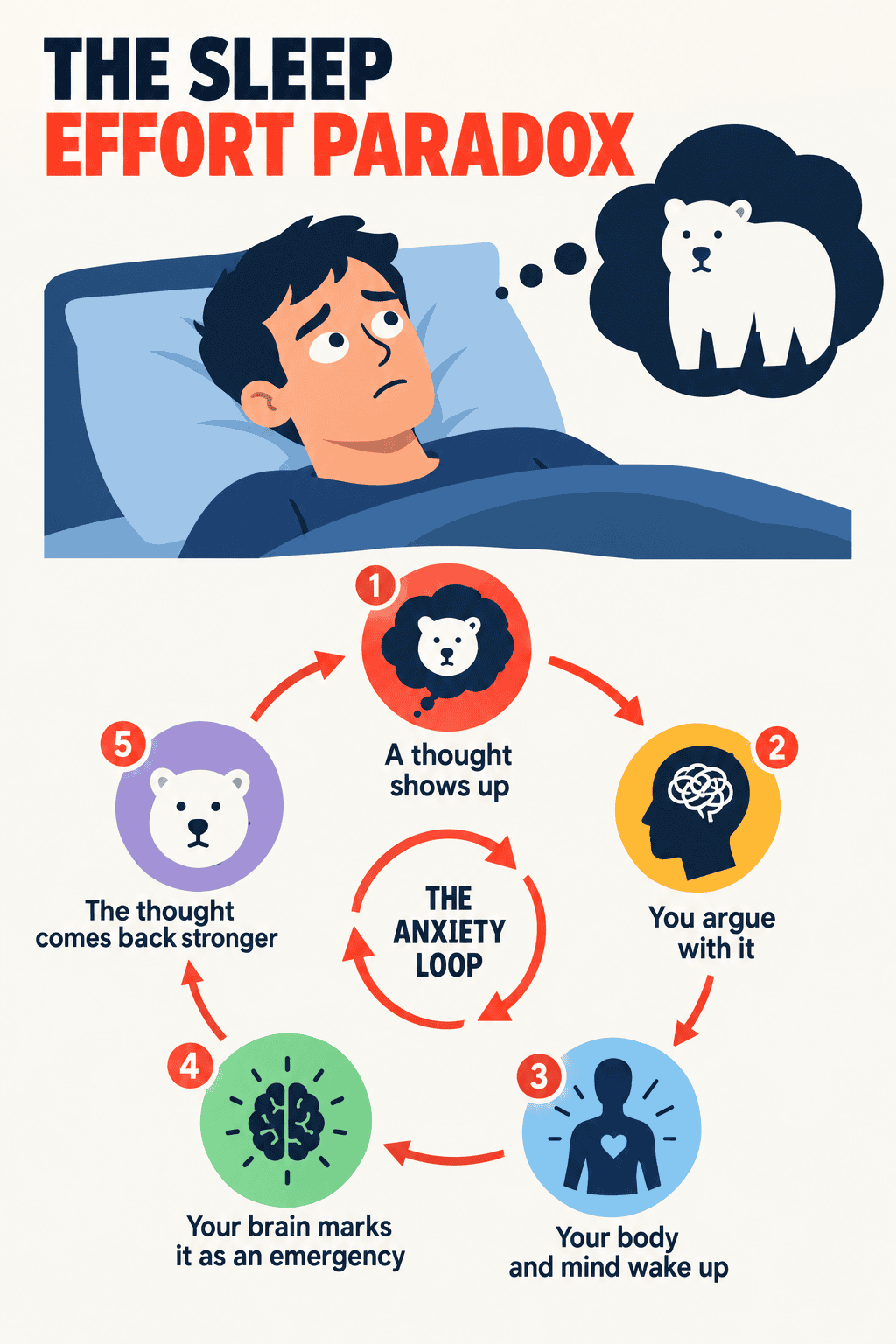
Put those together and you get a loop. A thought shows up and you answer it, the effort raises your arousal, your answer gives the thought new material, and your brain marks the whole thing as an emergency worth scanning for.
Sleep researchers see the same pattern from the outside. A 2023 systematic review in the Journal of Sleep Research, by Tang and colleagues, reported that most people with insomnia name a busy mind as the main cause of their sleep trouble, well ahead of a tense body.
A 2026 paper in the same journal, by Mombelli and colleagues, goes further and lists suppression and avoidance among the things that keep sleep problems going.
So I had been feeding the thing I was trying to starve, and even once I understood that, part of me refused to stop.
The part of me that didn’t want to stop
I know it’s hard to fight back against the anxiety, and what I’m going to suggest is that you put the fight down, which can feel even harder. Part of you will say that letting the thought run is careless.
That part has its reasons. In a lab study of 268 people, worry and rumination softened the jolt people felt when they were shown upsetting films, which fits what researchers call the contrast avoidance model.
In plain terms, staying braced protects you from a sudden emotional drop.
The bracing has no effect on real events, and yet it feels protective because it spares you the shock. One woman on a parenting forum put it plainly: “if I stop worrying I know that’s when something bad is going to happen.”
At 3am I had my own version of this belief, even though I’d never said it out loud. If I stopped arguing, the thought would win, and if it won it might turn out to be true, so my arguing felt like guard duty.
The “one more time” feeling is the same guard in a different coat. It tells you that one more pass will close the matter, and because it feels like careful thinking, you hand it another twenty minutes without noticing.
Once I could see the guard for what it was, I could try something different with the next thought, which arrived right on time.
What it looked like to just watch
At about 3:40 the job thought came back, word for word. This time I said “ok, whatever” inside my head and left it there.
I’d borrowed that line from someone on a forum who used to “lawyer” their intrusive thoughts. They wrote that “the lawyering helps a few times, then you see that the problem is solved in logic but persists in repetitive droning,” and that the best way to handle a troll is to take away its attention and energy.
The thought didn’t like being ignored. It came back within seconds with the email, and then with a picture of me packing a box at my desk, and each time I let it say its piece and gave it nothing back.
Harvard Health makes a similar point in plain terms. Racing thoughts often get worse because of anxiety about having racing thoughts, so its first suggestion is to give yourself permission to have them.
The clearest description of what I was doing comes from metacognitive therapy, which calls it detached mindfulness. A 2026 paper by Myers in Frontiers in Psychiatry sets out its parts, and two of them matter most at 3am.
The first is low conceptual processing, which means you don’t analyse the thought or build on it. The second is low goal-directed coping, which means you make no attempt to control the thought or push it down.
It also needs no breathing exercise or meditation, and because I had always assumed watching meant some kind of relaxation routine, that part took me a while to accept.
Adrian Wells, who created metacognitive therapy, offers an image of thoughts as clouds drifting across the sky. He has also said that the picture itself involves some active work with the thoughts, which freed me from trying to imagine anything clever, so I just let the sentences come and go.
I can’t tell you the exact moment I fell asleep, and I think that is the whole point. The last time I looked at the clock it said 4:12, and the next thing I knew my alarm was going.
The next morning I wanted to know whether I’d simply got lucky, so I went looking for the research.
Why watching beats winning
A 2023 trial of an app called Mello, built for young people stuck in repetitive negative thinking, gives the cleanest numbers I’ve found (2).
It measured two skills. One was defusion, which means seeing a thought as a thought without judging it, and the other was reappraisal, which means changing what the thought says.
Defusion improved with a moderate to large effect, a d of 0.67. Reappraisal moved by 0.36, a change too small to count as real in the statistics, and the authors concluded the app worked mainly by changing how people related to their thoughts.
Two other numbers stood out to me. Confidence in handling negative thinking rose with a very large effect of 1.66, while awareness of their own rumination patterns barely moved, at 0.10 and 0.19.
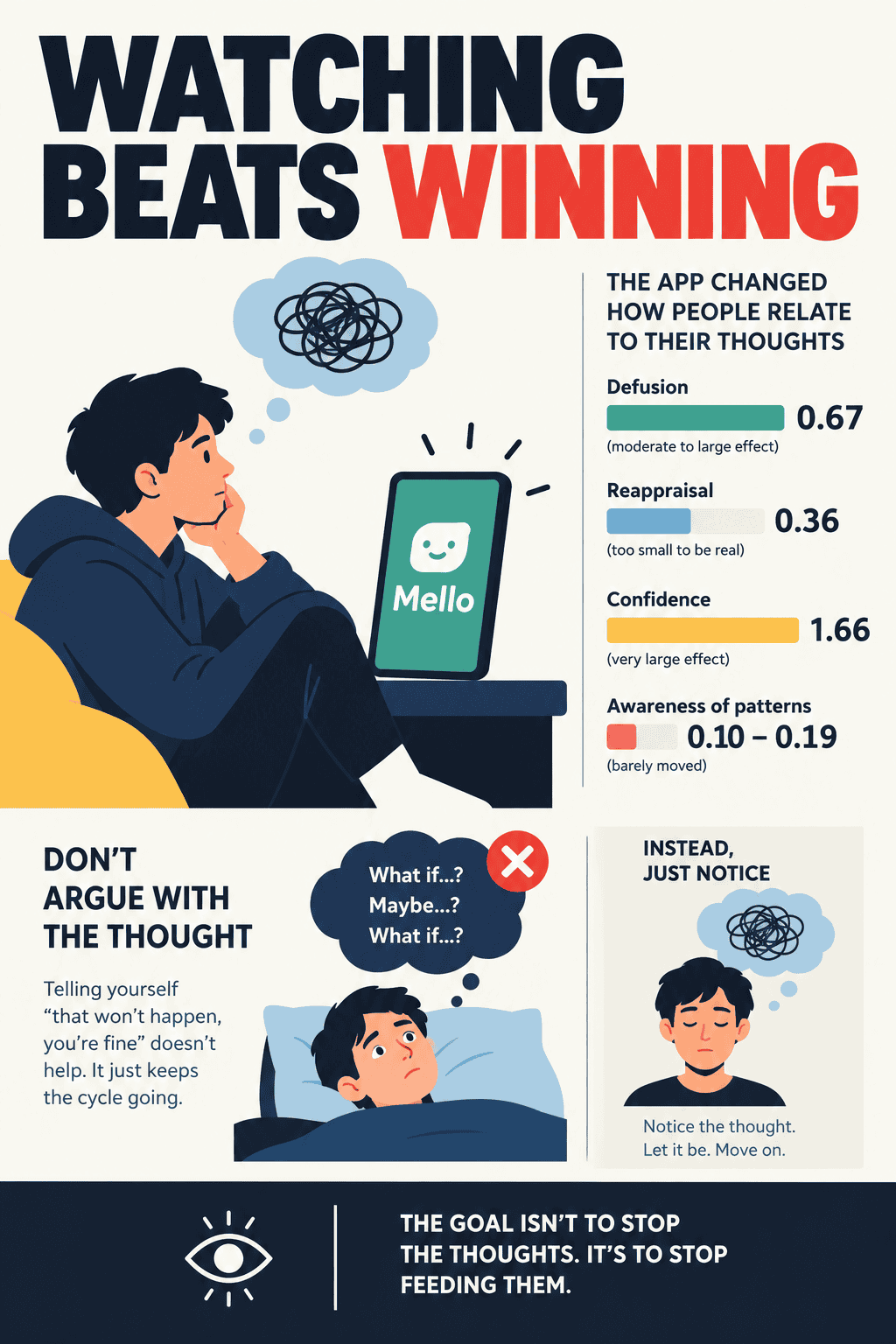
That matters if you’ve spent years trying to work out why you spiral. The people in this study felt far more able to cope, and they knew no more about their patterns than when they started.
The same lesson shows up in therapy for obsessive thoughts. Jonathan Abramowitz and Joanna Arch, writing in Cognitive and Behavioral Practice in 2014, called it a trap when therapists try to convince a patient that a frightening thought is illogical or unlikely, with lines such as “You’re such a gentle person; you’re not going to act on it” (3).
Their worry was that it teaches the person that a thought has to be cancelled out by argument before they can rest. When you lie there telling yourself “that won’t happen, you’re fine,” you’re giving yourself the same well-meant reassurance, and it carries the same cost.
A 2026 insomnia programme from Valencia, run by Viguer and colleagues, took the idea further. Over six short weekly sessions it worked on mental overactivity, meaning going over the past and worrying about the future, including worry about poor sleep.
Its main paradoxical tool was to try on purpose to stay awake as long as possible.
Trying to stay awake sounds backwards until you remember the effort paradox. Once you drop the goal of shutting your brain off, the effort that was keeping it running has nowhere left to go.
You might still wonder whether any of this matters if your body is waking you on a chemical schedule, and I wondered the same thing.
What about the cortisol thing?
You’ve probably read that 3am waking is a cortisol spike. One popular forum post blames it entirely on that, and the idea spreads because it feels tidy and takes the blame off your mind.
The sources disagree with each other, though. One explainer says cortisol hasn’t started its early morning rise by 3am, others say the rise begins between 2 and 3am, and a 2025 peer-reviewed review of the morning cortisol response carries the words “Fact or fiction?” in its title.
I stopped leaning on that story for a simple reason. Even if your body does wake you at 3am, what keeps you awake is how you deal with what you wake up to, and that part is in your hands.
When I used to type how to quiet brain at 3am into my phone in the dark, I was hoping for an off switch. The lever I could actually reach was my response to the first thought, and I’d been pulling it the wrong way for years.
Knowing that helped, but the real test was whether it would hold up the next night.
The next night, and the one after
The job thought showed up the next night too, at 2:50. I said “ok, whatever” again, and it came back almost as soon as I’d dismissed it, which rattled me for a minute.
That kind of rebound is normal, and the forum commenter who let thoughts in and skipped the investigating found the same thing. The thoughts popped back quickly at first and then came less often once the processing stopped.
It helps to keep your hopes the right size, too. In lab work, a single defusion exercise, such as saying a word over and over until it turns into noise, lowers how believable and upsetting a thought feels by a modest amount, and it works best as part of a wider practice.
So treat that first quiet night as a turning point and expect practice after it. Some nights you’ll catch yourself three rounds into an argument before you notice, and the move then is the same, which is to stop replying and let the thought keep talking.
If you’re asking how to stop engaging with racing thoughts, my answer is that you stop answering them and accept that they’ll keep knocking for a while.
Giving yourself permission is the skill, and you get better at it the way you get better at anything, by doing it badly and then doing it again.
If your nights stay rough for weeks, look for a therapist trained in CBT-I, which is cognitive behavioural therapy for insomnia, or in acceptance and commitment therapy. Both use structured versions of what I stumbled into, with someone in your corner to keep you at it.
I still wake at 3am some nights. The thought still shows up, sometimes about work and sometimes about something I said years ago, and I let it talk while I lie there, and most nights I don’t remember it finishing.
References
- Wegner, D. M., Schneider, D. J., Carter, S. R., & White, T. L. (1987). Paradoxical effects of thought suppression. Journal of Personality and Social Psychology, 53(1), 5-13. https://doi.org/10.1037/0022-3514.53.1.5
- Bell, I. H., Arnold, C., Gilbertson, T., D’Alfonso, S., Castagnini, E., Chen, N., Nicholas, J., O’Sullivan, S., Valentine, L., & Alvarez-Jimenez, M. (2023). A personalized, transdiagnostic smartphone intervention (Mello) targeting repetitive negative thinking in young people with depression and anxiety: Pilot randomized controlled trial. Journal of Medical Internet Research, 25, e47860. https://doi.org/10.2196/47860
- Abramowitz, J. S., & Arch, J. J. (2014). Strategies for improving long-term outcomes in cognitive behavioral therapy for obsessive-compulsive disorder: Insights from learning theory. Cognitive and Behavioral Practice, 21(1), 20-31. https://doi.org/10.1016/j.cbpra.2013.06.004