

A man of forty-eight once wrote about twenty years of working two jobs and doing the cleaning and cooking at home, all to keep his wife happy. Then one day he said a firm “No”, and she reacted as if he had sworn at her.
If you have spent years being the easy one, you probably know that story from the inside. The no that took you weeks to find the nerve for finally lands, and the other person looks at you as if you have turned into a stranger.
So you go back to yes, because the yes at least feels like you.
Underneath it all sits a fear that one woman put into a single line: “if being kind, loyal, always available to help isn’t my true personality, then who am I?”
I wrote this for her question, and for you if it is yours too. The ancient Stoics, who get quoted as the patron saints of not caring, actually built a way to stop living for other people’s approval while keeping your warmth in place, and they were strict about the warmth.
There is also one exact moment where people-pleasers slide back into the old pattern, usually a few seconds after a no that went well. Once you can see it coming, it loses a lot of its grip, and we will get to it near the end.
Stoic advice on caring what others think
The Stoics have a reputation as the people who stopped caring. You see it on mugs and in gym captions, where Marcus Aurelius is quoted like a man who shrugged at everyone he met.
One philosopher who has spent years teaching these texts calls that reading a common mistake, and he goes further. Seneca, Marcus, Epictetus, Musonius Rufus and Hierocles all describe things you have to care about to be even a mediocre Stoic, and people sit at the top of that list.
So a blanket habit of not caring is, in his words, “anti-Stoic”.
The confusion comes from one famous idea, the split between what is up to us and what is not. The Greek phrase is eph’ hēmin, and it points at ownership. Your choices and your conduct belong to you, because nobody can take them without your consent.
Your reputation and other people’s moods sit in the other column. That column holds things that can be taken from you at any moment, which is why they cannot be yours, and yet many of them still matter enormously.
Marcus is clear about where other people fit. In the second book of his Meditations he writes that “we are made for co-operation, like feet, like hands, like eyelids.”
So you can place someone’s opinion of you outside your control and still owe them honesty and decent treatment. Those two facts sit together comfortably once you see that the first is about what you own and the second is about how you act.
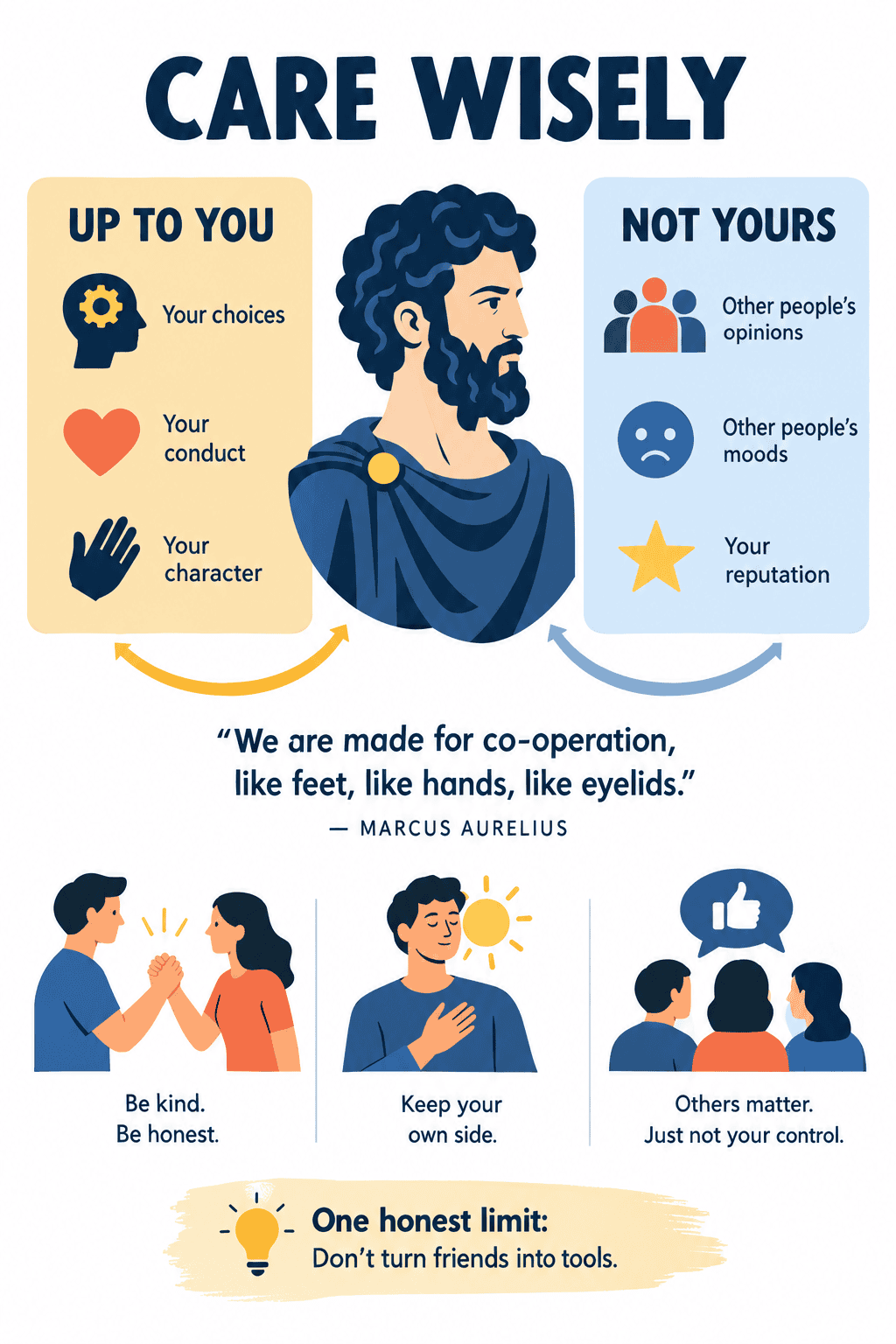
I will add one honest limit here. A writer on Epictetus has pointed out that strict Stoicism can make friends sound like handy tools for practising virtue.
He objects with a line I love: “I don’t keep you as a friend simply because it gives me chances to drive you to the airport.” I agree with him, and I think the warmth you feel toward people is real and worth keeping exactly as it is.
Which leaves a puzzle, because if caring is allowed, something else must be making your yes feel so heavy.
Fear dressed up as generosity
A Stoic writer who spent years as a people-pleaser himself named that something in one sentence: “People pleasing is a fear dressed up as generosity.”
He gives a single question to tell the two apart. Am I doing this because it is right and I want to help, or because I’m afraid of what happens if I say no?
Ask it honestly and you will find that some of your yeses pass easily. You love driving your sister to her appointments, and you would do it even if she never thanked you, so that one is kindness and you can keep it.
Others fail at once. You agree to cover a colleague’s weekend shift with your stomach already tight, because you can picture their face if you refuse.
The Stoics called your power of moral choice prohairesis, and they thought it was the one thing truly yours. When you say yes out of fear, you hand that choice over to the job of managing someone else’s feelings, which the same writer describes as “not being kind… being absent.”
People in one online discussion about this went a step further. They argued that pleasing works as a fear response, a way of feeling safe by keeping everyone’s emotions steady, which makes it an attempt to control how other people feel.
That is uncomfortable to hear when you have always thought of yourself as the giving one. It also means that when you stop, you are letting other adults have their own reactions, and that is a form of respect.
The hard part, of course, is that their reactions hurt you, sometimes far more than seems reasonable, and there is a good reason for that.
Why disapproval hurts, and why you can train for it
A cold look after a no can sit in your chest for a whole evening. Research led by Naomi Eisenberger at UCLA suggests why, since social rejection appears to share brain circuitry with the part of physical pain that makes it distressing (1).
So when saying no frightens you, you are reacting to something your body treats a lot like an injury. That is why it takes courage, and why you can be gentle with yourself about how long this is taking.
What the Stoics aimed at was the layer on top of the pain, which is the story you tell yourself about what the other person now thinks of you. And that story turns out to be much less accurate than it feels.
In 1993 the psychologists David Kenny and Bella DePaulo reviewed the evidence on how well people know how others see them (2). They found that our beliefs about other people’s view of us are shaped heavily by how we already see ourselves, and much less by any feedback we actually got.
Later work by Thomas Gilovich and his colleagues on what they called the spotlight effect found that people overestimate how much others notice their actions and appearance (3).
The audience you picture judging your no is mostly built in your own head, and it watches you far more closely than the real one does.
Marcus reached the same point without any lab. “Near is the forgetfulness of thee by all,” he wrote to himself, as a reminder that people think about you much less than you fear.
Epictetus adds the most hopeful part. In his Discourses he describes an orator who has written a good speech and learned it by heart, and who still shakes with nerves before he speaks.
The reason, Epictetus says, is that “he has been trained to be able to declaim, but he has not been trained in regard to praise and blame.” In plainer words, caring too much about opinion is a gap in training, and anything you were never trained in can still be practised.
So what does that training actually look like on an ordinary Tuesday?
How to stop seeking validation by sorting the opinion
It starts with something small, which is putting a face on the audience. “Everyone will think I’m selfish” is a huge, shapeless fear, and fears without a shape are the hardest ones to answer.
Marcus told himself to look at the “ruling principles” of the people whose praise he wanted, meaning the values that actually guide them. Epictetus was blunter with a student who craved applause, and asked him, “Do you wish to be admired by the mad?”
Once you have named the judge, ask a plainer question, which is whether you would take this person’s advice on this exact matter.
Your uncle who resents anyone who leaves the family business is a poor judge of your career change. He may still be a wonderful judge of how to fix a roof, so you can listen to him there and set his view of your job aside.
The next question keeps you from turning hard. Marcus wrote that he should change his mind whenever someone sets him right, as long as he is persuaded the correction is just or good for others.
Changing it because the new view felt pleasant or would win him a good name was, for him, a bad reason.
That lets you hear criticism without bracing against all of it, so when a friend says you were short with her, you ask whether it is true and fair, and if it is, you put it right.
The last question is the one I use most. When Marcus faced someone’s contempt, he wrote, “Let him look to that himself. But I will look to this, that I be not discovered doing or saying anything deserving of contempt.”
His job was his own conduct, and the verdict belonged to the other person. He also met that contempt with warmth, because elsewhere he tells himself to feel sympathy for people who wrong him, since anyone who misjudges good and evil deserves compassion.
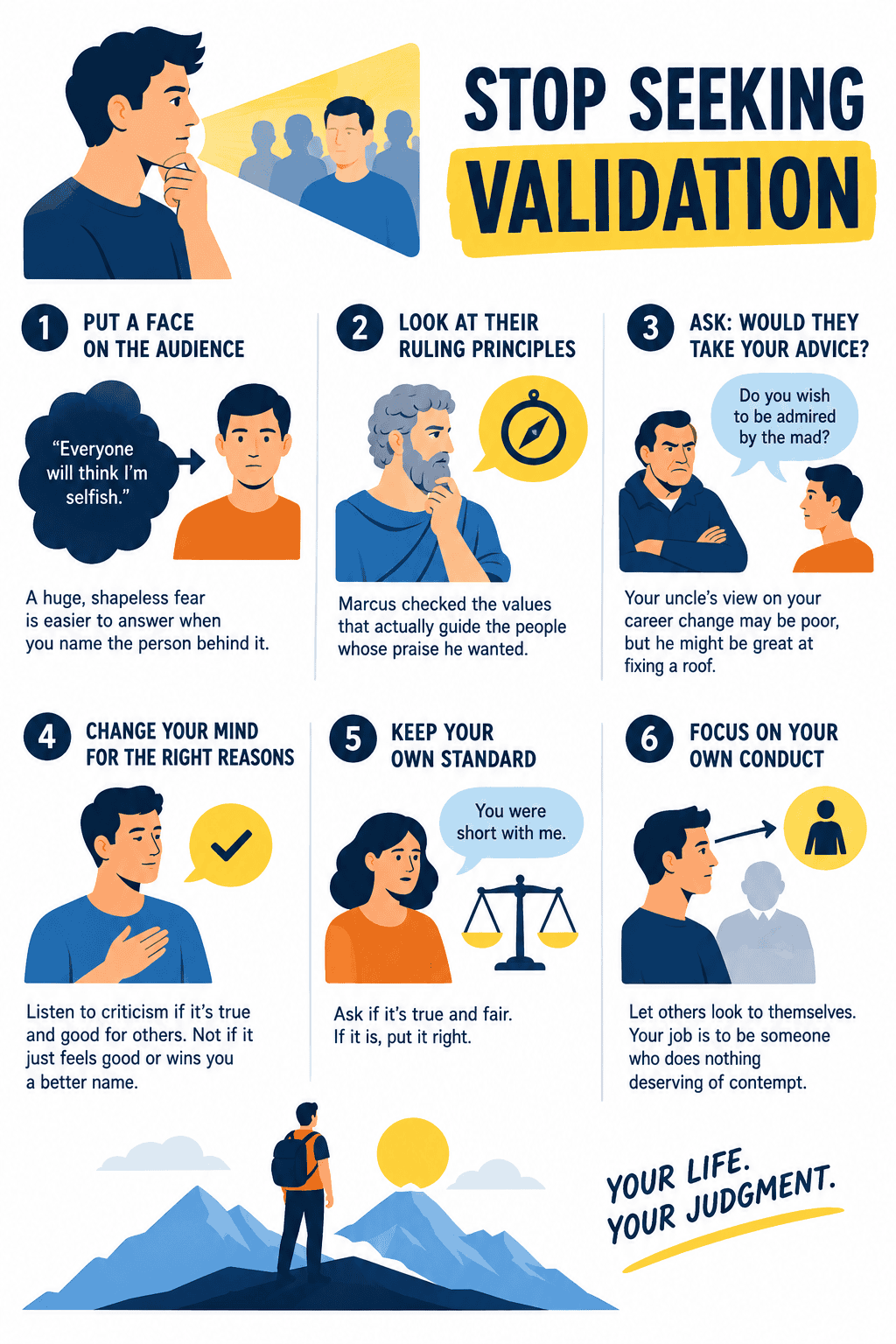
Those four questions take less than a minute once you are used to them. They also give you a clear answer to the book that many people-pleasers pick up first.
Where the courage to be disliked goes wrong
If you have read The Courage to Be Disliked by Ichiro Kishimi and Fumitake Koga, you will recognise some of this. The book draws on the psychologist Alfred Adler, and plenty of readers have found real relief in it.
Its central move is to call other people’s dislike “their task”, something you can leave entirely with them. One reviewer pushed back hard on that, arguing that if someone dislikes you because you are behaving like a bigot, you need to take that into account.
A commenter under her review added that “the consequences of being true to yourself diminish with each level of privilege.” Shrugging off disapproval is cheap for someone with power and costly for someone who could lose a job or a home.
The same commenter warned that if freeing yourself from others’ expectations does not also free them from yours, you have only redrawn the old line between master and servant.
There is a second concern that matters for many people-pleasers. In a large online community for survivors of complex trauma, one widely shared post warned others away from the book as “terrible advice for trauma survivors”, and the same reviewer objected to its claim that trauma is not real.
Plenty of people learned to please because, as children, being helpful was the safe way to belong. That history is real, and any approach that waves it away will leave you feeling worse.
The Stoic version holds up better here because it never lets go of your duties. You still owe people fair treatment, and Marcus’s test of whether a criticism is just stays in place, so the bigot cannot hide behind “that’s their task” and neither can you.
It also leaves your past where it belongs. Epictetus would say you were untrained, and an untrained person is someone who can still learn, whatever taught them the old habit.
Which brings us to the learning itself, and to that moment I promised at the start.
The courage to say no, one small practice at a time
Here is how I would start, with the smallest requests first, because small ones let you practise before the stakes feel high.
Pause before you answer
When someone asks you for something, you can take your time before you reply. “Let me check and get back to you this afternoon” buys you the minute you need to ask the fear question honestly.
The pause is where you move from reacting to choosing, and a choice made from a calm place is much easier to stand behind later.
Leave their disappointment with them
This is the moment I promised to come back to. You say no, the other person looks let down, and within seconds you are apologising and offering anything that might make the feeling go away.
That rush to repair is where the old pattern wins. The Stoic writer I quoted earlier puts it plainly: “that disappointment does not need to be fixed by you.” Letting them sit with it, he says, is “where the pattern starts to change.”
You can stay warm while you wait. “I can tell you’re disappointed, and I’m sorry it’s not the answer you wanted” is kind and true, and it leaves the no standing.
Expect a bigger reaction than the request deserves
Think back to the man whose wife reacted as if he had sworn at her. After twenty years of yes, his first no was a shock to the whole system they had built together, so the reaction was bound to be out of scale.
An outsized first reaction usually tells you how long the old pattern ran. Hold steady and keep your tone gentle while people get used to the person you are becoming.
Some people will refuse to adjust, and that is painful information. Without limits, the same writer warns, “you attract people who need you to stay small”, and you are allowed to notice who those people are.
Answer coldness with sympathy
When someone is sharp with you after a no, try the posture Marcus used. Their contempt is theirs to look after, and your part is to make sure you did nothing that deserved it, which leaves you free to feel some compassion for how upset they are.
Review your conduct at night
Before bed, go over the day’s requests with two questions. Did I act honestly and kindly, and was any criticism I heard true enough to act on?
Leave out the question of whether everyone liked you, because that one belongs to them. Over a few weeks, this habit trains exactly the skill the orator was missing.
The woman who asked “then who am I?” was afraid that under all the helpfulness there would be nobody kind left.
My answer is that the kindness was always yours, and once fear stops spending it for you, you finally get to choose where it goes.
References
- Eisenberger, N. I., Lieberman, M. D., & Williams, K. D. (2003). Does rejection hurt? An fMRI study of social exclusion. Science, 302(5643), 290-292. https://doi.org/10.1126/science.1089134
- Kenny, D. A., & DePaulo, B. M. (1993). Do people know how others view them? An empirical and theoretical account. Psychological Bulletin, 114(1), 145-161. https://doi.org/10.1037/0033-2909.114.1.145
- Gilovich, T., Medvec, V. H., & Savitsky, K. (2000). The spotlight effect in social judgment: An egocentric bias in estimates of the salience of one’s own actions and appearance. Journal of Personality and Social Psychology, 78(2), 211-222. https://doi.org/10.1037/0022-3514.78.2.211